
The Future is Offline
As our lives become always more digital and more connected, in the limit do we arrive in the metaverse or do we revert to offline?

Revert is a strange word here; reverting to offline.
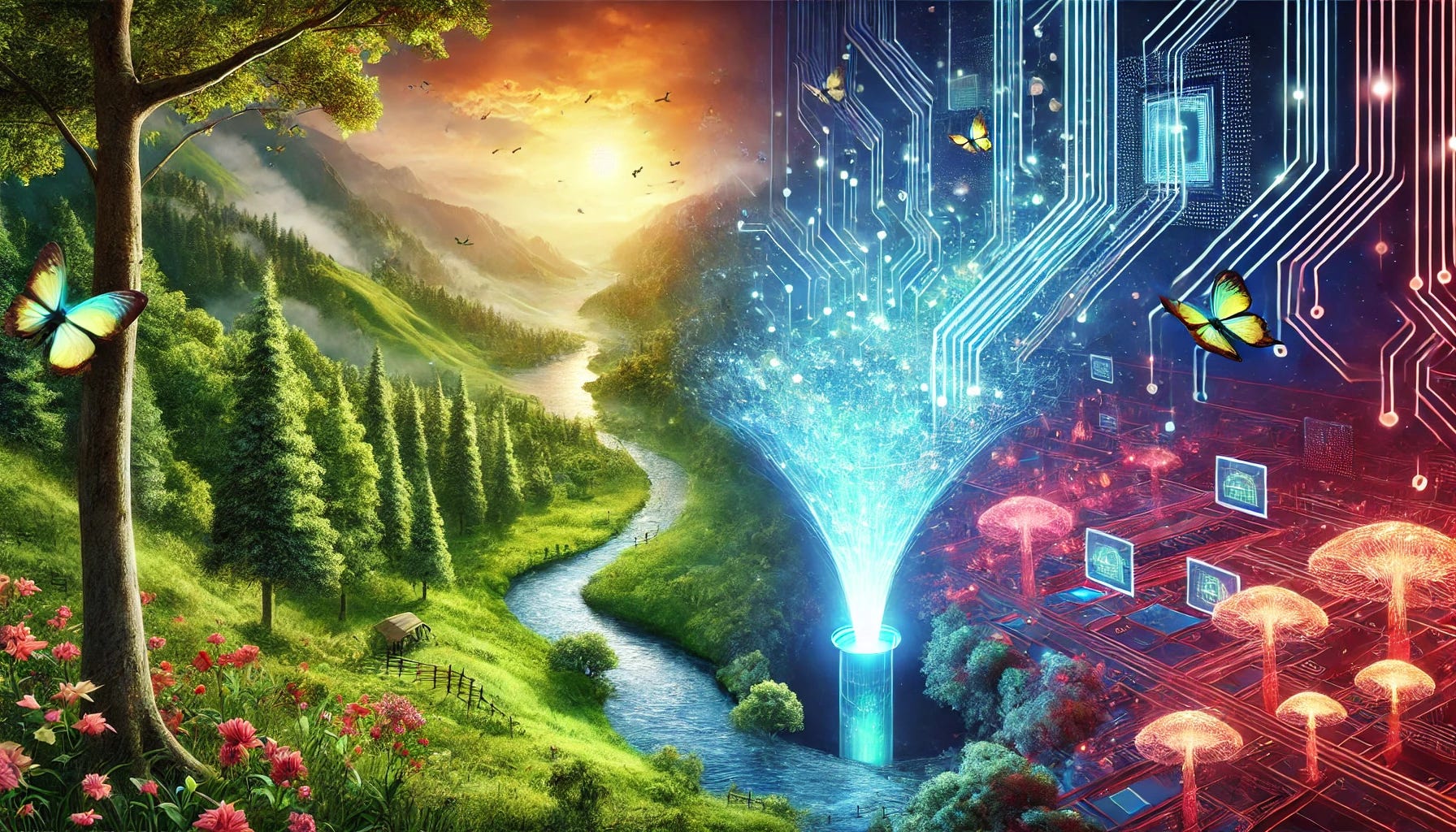
Lately I have been thinking about this a lot. As always, my thoughts are at the intersection of actually building tech and just being human.
Today I wonder to what extent the future will be more digital and connected versus more offline. The world of course will always become more digital and connected until there is nothing left to digitize and nothing left to connect. But the question is, where will we be? Will we live in this digital reality out of some necessity or are we allowed to revert to a predominantly offline existence - will our technology permit us?
And it seems strange to even think about being disconnected so I am forced to be a little more specific. Think about a certain word people don’t really use any more which is to “surf” the web. At one point it was a conscious decision to dial up with a modem - I can still hear those shrill blips and beeps as I connect to all of 56 kbits and go out into or onto the internet and poke around. You went in and then you came out. You went online and then returned offline - to real life.
And then there was search. And it is particularly the need to search and scroll that I am starting to question in our future…
Search emerged to allow us to deal with the overwhelming scale of the internet. It is the degredation of search in fact, that first had me thinking about a future offline world. As search is so bad, the internet in effect shrinks to about or below the size of what the early web directories first were. Google seems to to be just a fancy front page to the internet, contextualized by some keywords. You only see the tip of the iceberg and half of the tip may be promoted bits of cold marketing, propped up by auctions beneath the surface.1
If AI agents could do one thing for us, might they not understand our needs and search in the background “offline”. That would be offline for us, but they would always be online. And when they would find something truly valuable for us they could put it in a little vault somewhere. They would then either notify us (if that is our preference) or when we decided to look into it, we would go into our vault in our time. Our own time?
As it stands, the first generation of AI search remains in, or rather keeps us in, this online world. These are called answer engines now but we have to come online to use them. Behind the scenes they still use the same bad search over a slice of the internet. As of 2025 they use this when doing "deep research”, which we are asked to stand back and wait for. At the time of writing, Perplexity takes only three minutes to complete this deep research.
To me the promise of AI is simply better UX - its not AGI and I don’t even really expect any creative intelligence. Its not solving theorems or inventing new things that maybe we don’t even understand. Generative AI is incredible because it can help us generate content quickly that would otherwise take us more time. Maybe that means we can spend less time connected to our digital devices to achieve the same goals. Maybe it means we can create at the speed of thought. While eventually we could use technology to create at the speed of thought using voice or thought, even doing this faster via “traditional” interfaces can mean less time connected to our devices and, by extension, less time online.
Maybe you believe people want to be online? Perhaps some do. Often our choice to be online is in one way or another anxiety-induced, whether that be for work or some other reach for self-actualization. In the limit, can being online and connected for the majority of our weeks ever be the best thing for us? Can it really? The future is not the metaverse.2
Here on Substack and elsewhere you will see people asking these sorts of questions. While these are small samples, there is coherence in the sentiment. For example here and here and here and here and here. Such sentiment is easy to fob off as impractical, being on some spectrum where in the extreme, long-haired crusty individuals live off-grid and completely turn their backs on society. But lets reel that back in for a second. What I am considering for AI as UX is a promising future that provides the utility that we need from our technology without the emotional and social cost.
So, I’m going to start building my AI agent and my vault. Ill put quality information in to it and ill generate quality content from those raw ingredients. Personally, I’ll spend time in the mountains and in the forests, hiking, while my agent-robot-slave-thing muddies itself online for me. There will be no adds in my vault and no clickbait. Over time I’ll think of my agent as the gardener, pruning away the weeds in the vault. And no, the weeds are not the slop that should never have got into the garden in the first place - those will already be filtered out by my agent-robot-slave thing. The weeds are merely the things I no long have time to think about, which could, overtime, drain my attention.
Although the information in my vault will never be me, I might come to see that it in some way represents me. And maybe Ill share it.
I feel like im being unfair on Google here but this is what we have in effect despite incredible technology. Its the business that sucks, not the tech.
This morning I saw an absolutely cringe ad for Meta Horizon and I need to wash my eyes and somehow erase it from my memory. I’m not going to share it here to spare you (don’t search for it).